Get in touch with TIME Company


Hydraulic test points diagnostic couplings microbore test hoses and RFQ replacement checks
ISO 15171-2 & Compatibility Guide is a buyer’s compatibility checklist for M16 x 2 diagnostic-interface clues, not a complete replacement approval. A safe match still needs the standard family, port or stud end, seal path, pressure chain, fluid, hose bore, gauge end, and inspection evidence.
For procurement, maintenance, and private-label sourcing teams, this is essential to avoid common false-positive orders where an M16x2 coupling installs but does not prove the entire assembly for machine operation, gauge connection, or connection-under-pressure use. This guide filters that knowledge into practical M16x2 compatibility testing for M16x2 test points, STAUFF Test 20 search filters, Minimess 1620 replacements, and TIME Hydraulic drawings.
Updated August 2026.
Quick answer
The standard describes hydraulic couplings for diagnostic purposes, Part 2, with an M16 x 2 connection end for connection under pressure. Public evidence supports connection under pressure up to 40 MPa / 400 bar, while the maximum working pressure of 63 MPa / 630 bar is a separate context that does not override the lowest-rated part in the finished assembly.
M16 x 2diagnostic connection end in this scope
40 MPaconnection-under-pressure context
63 MPamaximum working-pressure context
DN2 / DN42 mm / 4 mm TIME custom hose bore options
Key points for buyers
- Don’t let M16x2 fool you into assuming it proves port, seal, pressure, fluid, hose or gauge compatibility in its own right.
- Do Not Commingle: Use “connection under pressure” for the live-connection series, not for higher working-pressure parts.
- Non-mineral fluids MUST be negotiated by the supplier and buyer at the order level.
- Separate use from ISO 15171-1, SAE J1502, ISO 16028 prior to any cross-reference activity.
- Demand photos, drawings, pressure ratings, hose IDs, and mating threads on the gauge side with every replacement request part number.
What the M16x2 Standard Actually Covers
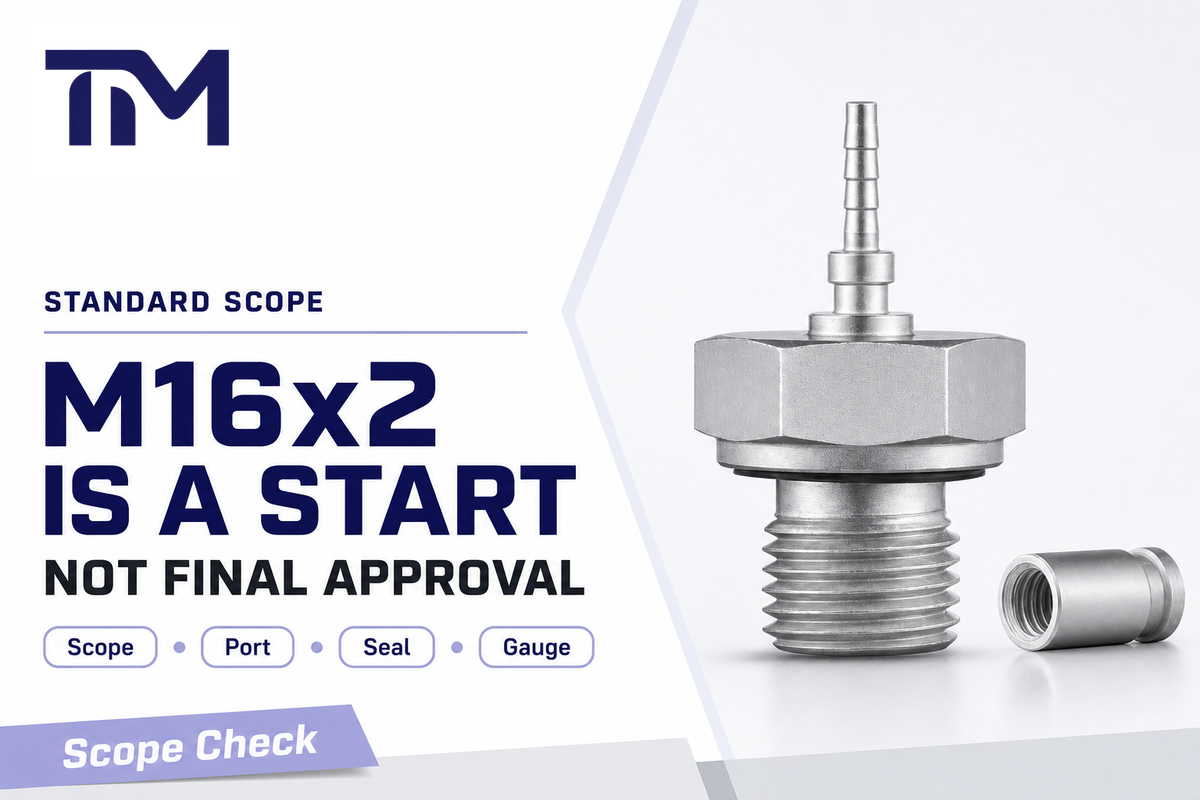
The standard defines a limited family of diagnostic couplings for hydraulic fluid power, not all hydraulic test points that might carry a similar thread. Official records identify the 2016 edition as published and frame the standard around an M16 x 2 interface for connection under pressure in mineral-oil hydraulic systems.
For buyers, the useful translation is narrow: use this standard-family language when the diagnostic-interface family, connection end, port or stud-end path, pressure, fluid, and document trail are part of the same evidence chain. That standard name should not replace the machine-port drawing, seal-surface review, hose rating, or gauge rating.
In TIME drawing review, the standard name is the start of the check, not the end. A quote still has to prove the port, seal, pressure, hose, gauge, and fluid.
TIME Hydraulic application engineering team
For formal purchasing language, avoid saying “standard-compatible” when the only confirmed field is M16 x 2. A more useful line is: “Diagnostic-interface candidate for this M16x2 context, M16 x 2 interface, connection under pressure required, port or stud end to be confirmed from drawing.”
The 3-Layer Compatibility Lock
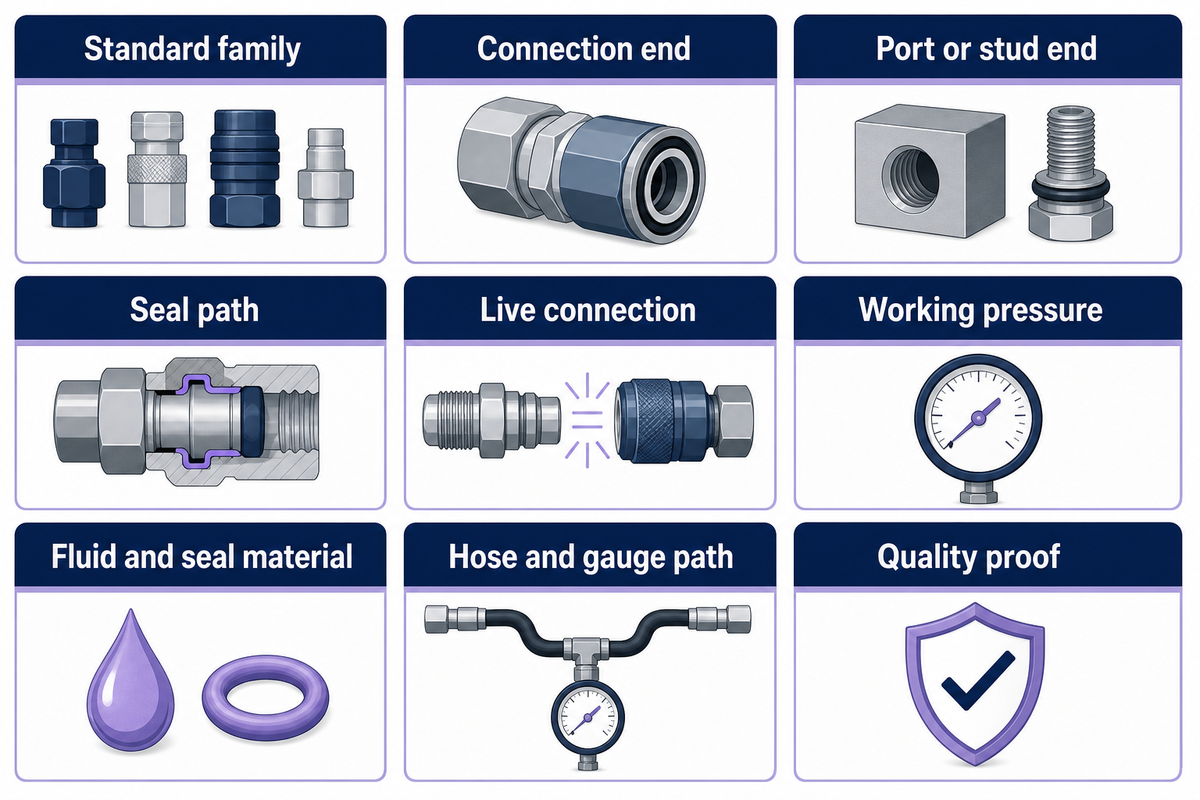
For replacement work, the “3-Layer Compatibility Lock” is a procurement screen where any missing element fails the candidate coupling. First prove the standard family against the public standard scope, then prove the machine-side port or stud-end dimensions, then prove the pressure, fluid, hose, gauge, seal, and documentation chain.
This filtering process is useful any time a procurement team sees search terms such as Minimess 1620, STAUFF Test 20, EMA, Press-Check, Minimess, TIME, supplier cross-references, or simply “M16x2 test point.” These names can open the search, but they cannot close the engineering approval.
| Layer | Evidence to collect | Pass condition | Limitations / Not suitable for |
|---|---|---|---|
| 1. Standard family | This standard family, ISO 15171-1, SAE J1502, ISO 16028, or supplier family | Same standard family, not only similar use case | Not suitable when only “diagnostic interface” is known |
| 2. Connection end | M16 x 2 interface, part number, series, and mating half | Mating geometry and connection end agree | Not suitable for M16 x 1.5 or S12.65 x 1.5 assumptions |
| 3. Port or stud end | standard stud-end callout, BSP/UNF/metric port detail, or drawing | Machine-side port or stud end is confirmed | Not suitable when the installed port is only photographed from one angle |
| 4. Seal path | Cone seal, O-ring seal, flat seal, washer, or supplier section drawing | Seal surface matches the mating part | Not suitable when thread engagement is used as the only sealing evidence |
| 5. Live connection | Connection-under-pressure requirement and 40 MPa live-connection limit context | Live-connection need is stated separately from working pressure | Not suitable when buyers infer disconnection-under-pressure approval from the standard title |
| 6. Working pressure | 63 MPa maximum-working-pressure context plus supplier rating of every part | Lowest confirmed component rating controls | Not suitable when burst pressure is treated as normal working pressure |
| 7. Fluid and seal material | Mineral oil, non-mineral fluid, NBR, FKM, EPDM, stainless, or plated steel | Fluid and seal material are accepted by supplier and purchaser | Not suitable for water-glycol, phosphate ester, or aggressive fluids without review |
| 8. Hose and gauge path | DN2, DN4, hose length, adapter, gauge, sensor, or data recorder end | Instrument side matches the measurement task | Not suitable when the machine side is known but the gauge side is omitted |
| 9. Quality proof | Inspection record, material traceability, pressure test, warranty, and certificate scope | Supplier can document the delivered assembly | Not suitable when certificates or inspection scope are assumed from catalog copy |
That 3-Layer lock is stricter than a catalog cross-reference because it assigns ownership. Plant managers carry downtime and safety risk, QA carries leak and inspection risk, procurement carries supplier-selection risk, and finance carries rework and rejected-order cost.
M16x2 Is Not the Whole Match
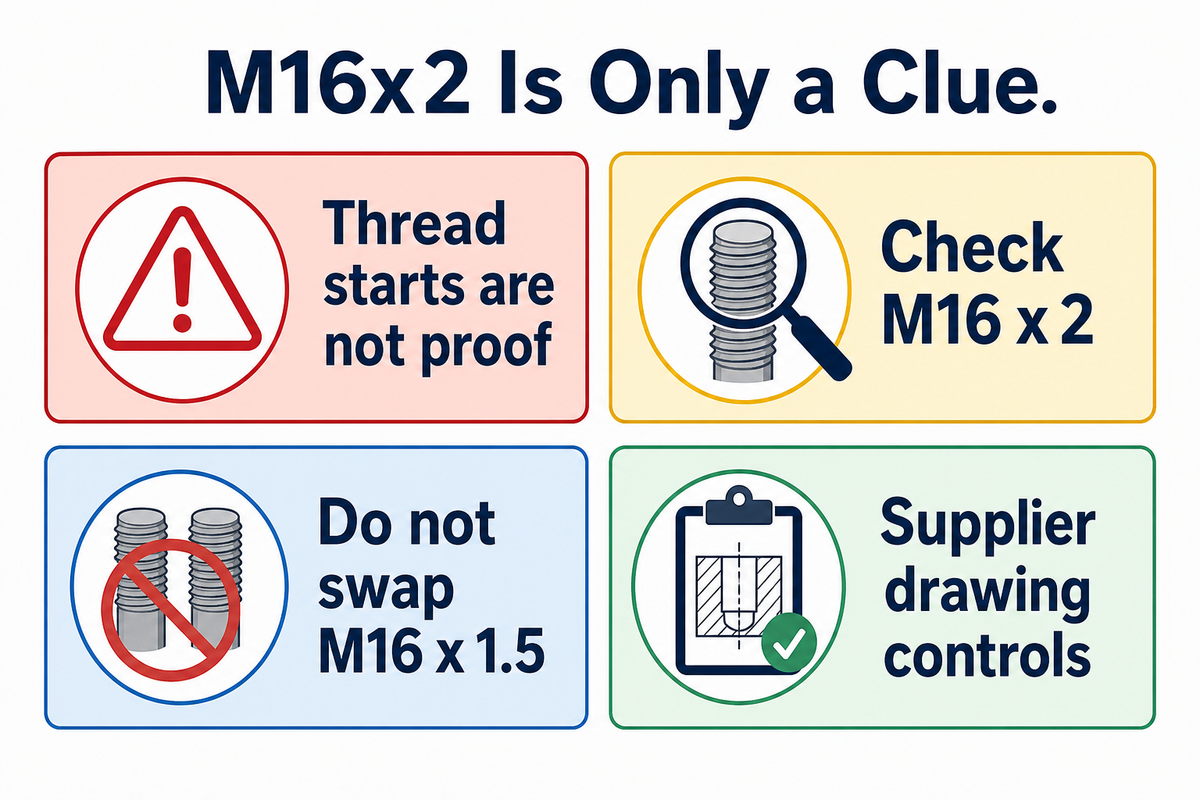
The public M16 x 2 scope is a useful search boundary, but it doesn’t show seal design or port thread or pressure rating. An open thread on a hydraulic test point doesn’t imply seal path or series or connection-under-pressure service.
Usually, the biggest search problem is not that buyers lack thread names. It is that search names cluster together: M16 x 2, M16 x 1.5, S12.65 x 1.5, Minimess, STAUFF Test 20, and generic diagnostic-interface language. A buyer still has to turn those names into part-level evidence.
Do
- Ask for the legacy part number and installed-port photo.
- Measure outside or inside thread diameter and pitch.
- Confirm the seal surface and pressure class.
- State whether live connection under pressure is required.
Don’t
- Approve a replacement because the thread begins to engage.
- Substitute M16 x 1.5 or S12.65 x 1.5 for M16 x 2 without supplier proof.
- Use a broad “fully interchangeable” catalog sentence as final evidence.
- Forget the gauge, sensor, or test hose end.
Broad interchangeability language exists in the market, and it is useful because it shows what buyers will read. Treat those labels as candidate-match signals, not as a universal rule. Final sourcing authority should come from the drawing, mating half, pressure, seal, fluid, and supplier confirmation.
Live Connection vs Working Pressure: Which Limit Governs?
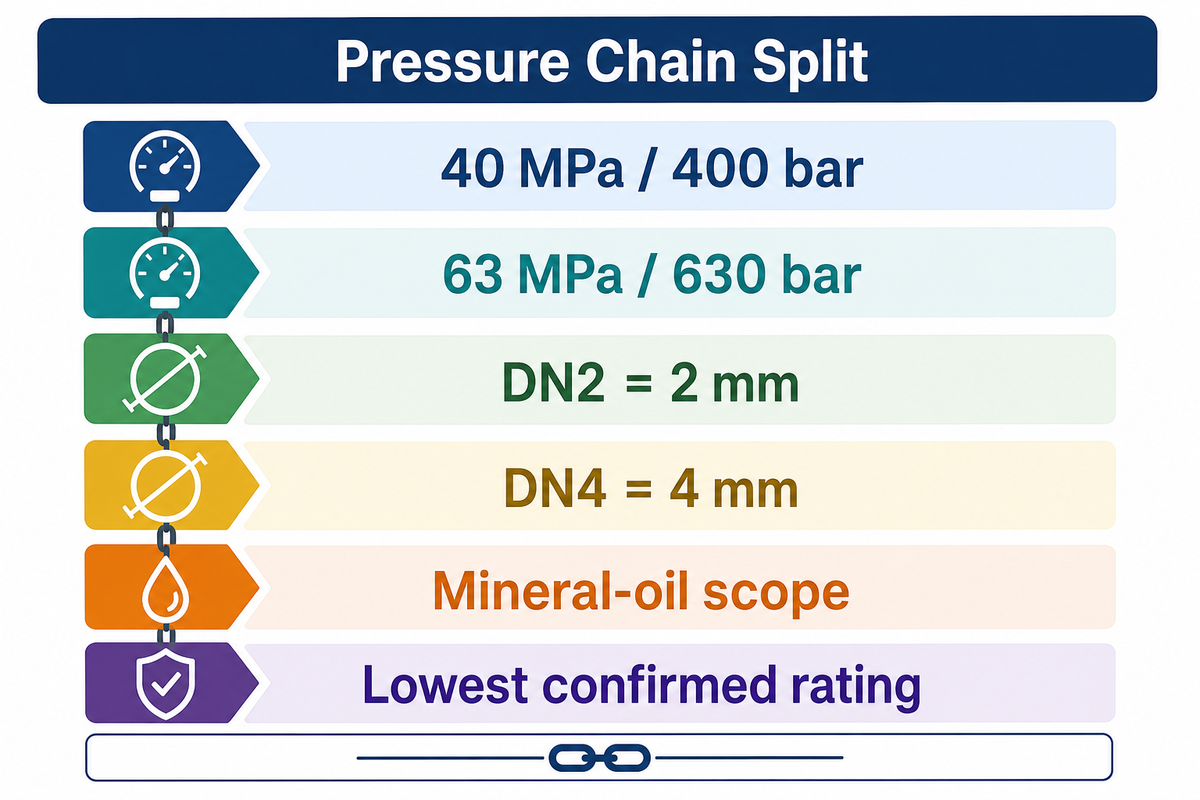
The two pressure numbers answer different questions. The public standard wording supports connection under pressure without tools up to 40 MPa live-connection limit, while the 63 MPa maximum-working-pressure language appears as a separate coupling context with design and application caveats.
Do not generalize those numbers into “test at the higher working-pressure rating” without product-specific documentation. Actual fluid power test-connection pressure should follow the lowest rated component in the chain, including the test point, adapter, hose, gauge or sensor, valve, seal material, and installed port.
| Question | Evidence needed | Number to keep separate | Buyer action |
|---|---|---|---|
| Will the user connect while pressurized? | standard scope plus supplier datasheet | 40 MPa live-connection limit | State connection-under-pressure need in the RFQ |
| What is the normal working pressure? | Coupling, hose, adapter, gauge, and test-point ratings | 63 MPa maximum-working-pressure context where supported | Use the lowest confirmed rating |
| Which hose bore is selected? | TIME custom hose page or drawing | DN2 = 2 mm; DN4 = 4 mm | Match bore to routing, response, and handling |
| What is the fluid? | Mineral oil or exact alternative fluid | Mineral-oil scope | Get supplier and purchaser agreement for other fluids |
| Which seal material? | NBR, FKM, EPDM, or other seal callout | Temperature and fluid limits vary | Confirm seal material before ordering |
| What is the instrument end? | Gauge, sensor, data logger, or adapter thread | Gauge range and thread are separate fields | Do not stop at the machine-side test point |
Most replacement orders are delayed at this point in the chain: the part number is visible, but the lowest-rated component has not been verified.
Keep RFQ units explicit: write 40 MPa live connection, 63 MPa working pressure where supplier evidence supports it, DN2 or DN4 hose bore, the M16 x 2 machine-side clue, and the required gauge range as separate fields.
Port Threads and Stud Ends in the Standard
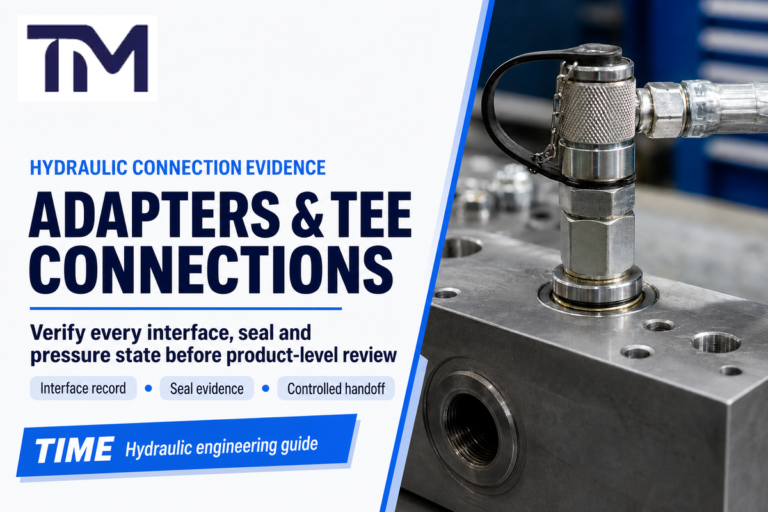
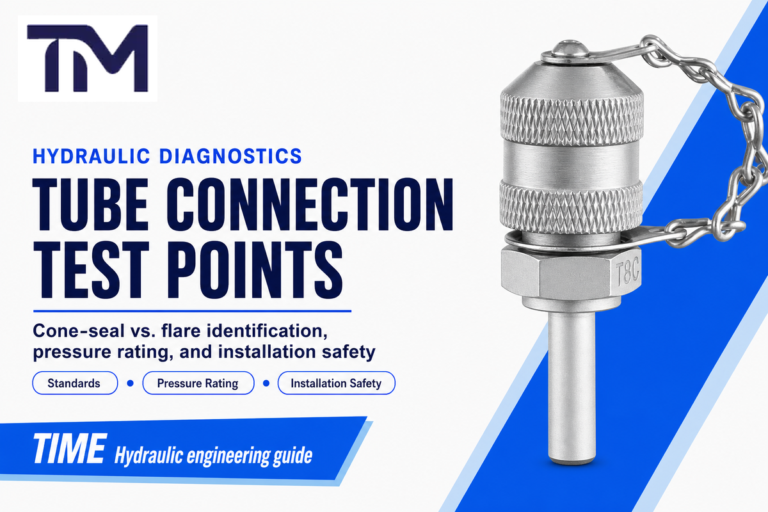
For selection support, review bulkhead and stud test points when the specified connection family matches the drawing and operating conditions.
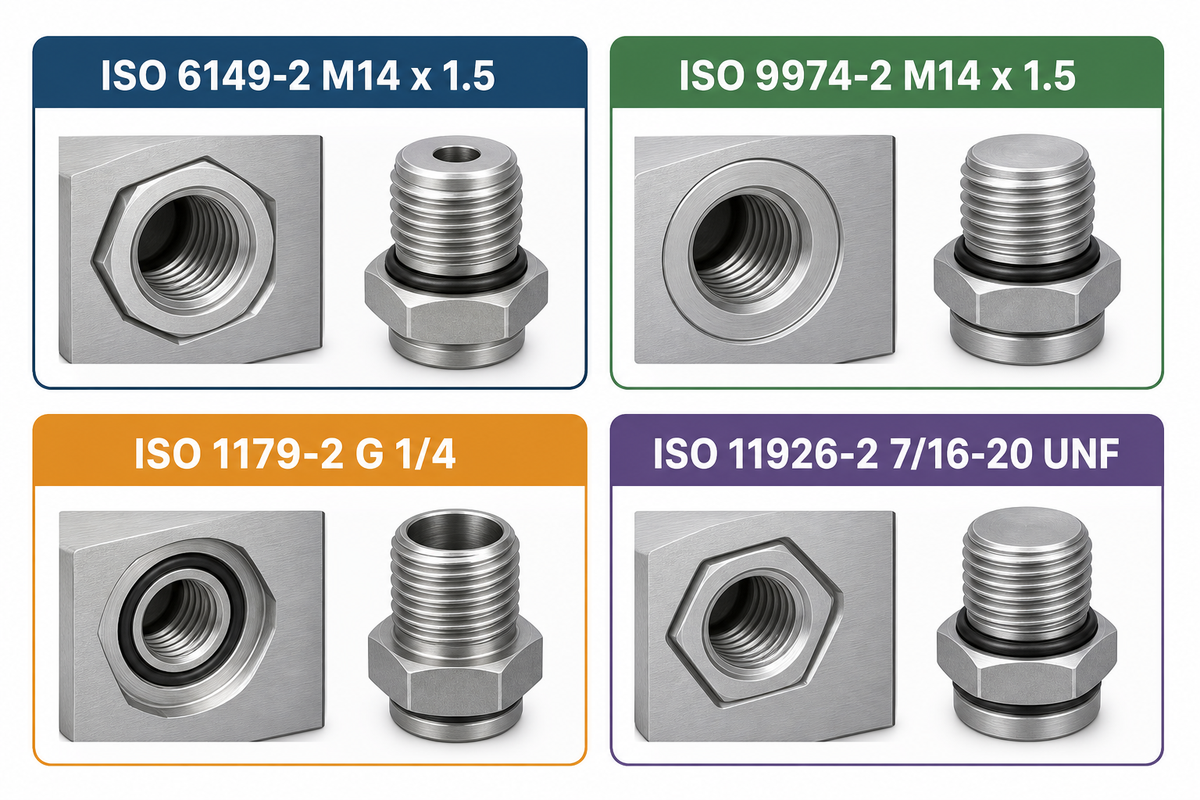
Proof that a standard-family candidate is compatible requires review of ports and stud ends, even when the first clue is the M16 x 2 diagnostic connection end. Public standard surface evidence lists stud-end references such as ISO 6149-2 M14 x 1.5, ISO 9974-2 M14 x 1.5, ISO 1179-2 G 1/4, and ISO 11926-2 7/16-20 UNF; the full standard, part number, and supplier drawing should control final purchasing language.
TIME and general RFQs also surface fields such as BSP, NPT, metric, JIC, DKO 24 cone, O-ring seal, and flat seal. These are separate compatibility fields, not synonyms.
When you discover such detail on referenced standard drawings, supplier drawings, or distributor product pages, do not simplify it as only “thread size.” Buyers may reference stud ends with ISO 261 threads, threads and O-ring sealing, ISO 1179 series fittings, or ISO 9974 series and ISO 11926 connectors. Treat those as product-feature details tied to performance requirements and test procedures, even when the item looks like a simple fluid coupling on hydraulic machinery.
Buyer note: write the connection as a chain
Instead of “M16x2 test point,” write “standard-family diagnostic-interface candidate, M16 x 2 interface, machine-side port or stud end to be confirmed, seal form required, working pressure and live-connection duty required.”
When the machine drawing is missing, photos can still help. Send one photo of the installed port, one close photo of the seal surface, one measurement photo with caliper or pitch gauge, and one photo of the instrument end. A supplier can screen faster when the evidence is organized by the chain.
STAUFF Test 20, Minimess 1620, SAE J1502, and ISO 16028
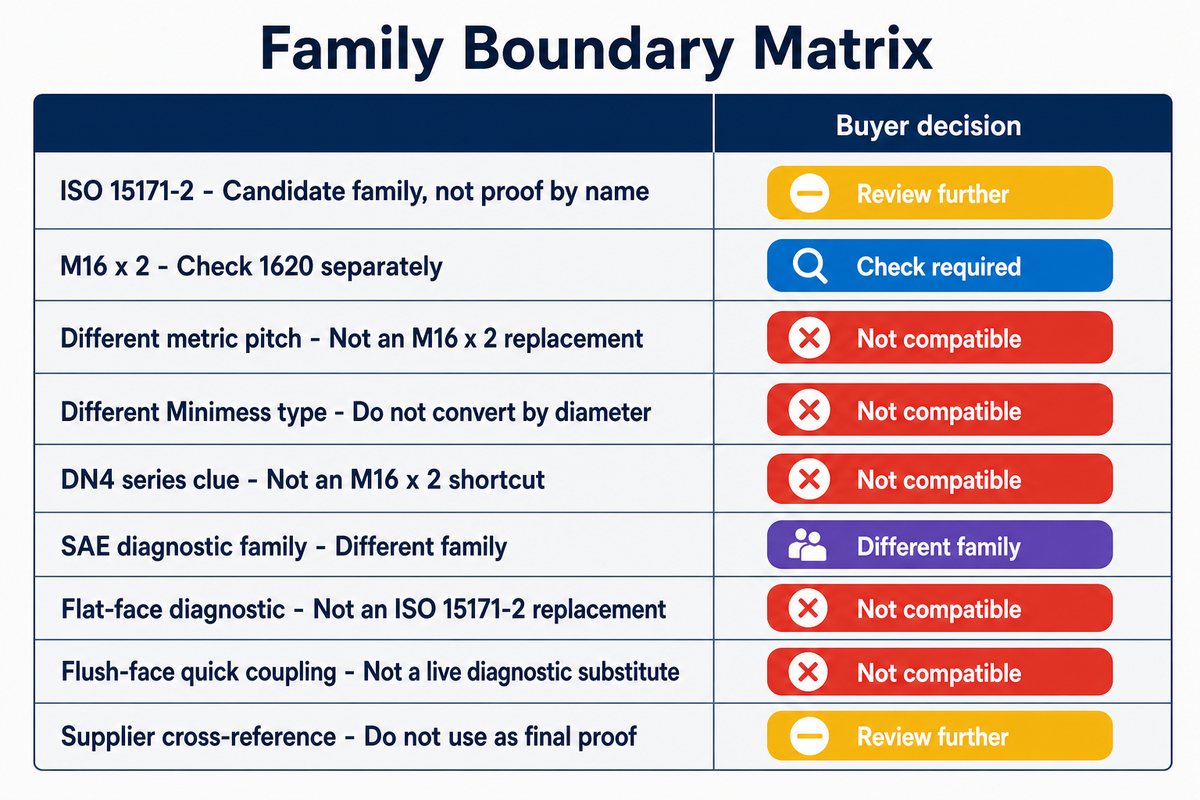
Series names and adjacent standards do help buyers search, but do not provide interchangeability of parts. STAUFF Test 20 and Minimess 1620 are suitable M16 x 2 diagnostic-interface candidates; STAUFF Test 15 M16 x 1.5, SAE J1502, ISO 15171-1 flat-face diagnostic couplings, and ISO 16028 flush-face quick-action couplings are not valid replacements.
SAE J1502’s public page is narrower than a generic “diagnostic interface” label. It covers connections for fluid power and general use hydraulic diagnostic couplings with a male half and specific stud-end language. ISO 16028:2023 is a flush-face quick-action coupling standard, with public pressure range language from 10 MPa to 31.5 MPa, or 100 bar to 315 bar, and is not designed as the M16x2 live diagnostic test-point replacement.
| Compatibility type | Name buyers may search | Useful signal | What still must be proven | Compatibility caution |
|---|---|---|---|---|
| M16x2 standard candidate | STAUFF Test 20 | M16 x 2 standard-family context | Part number, mating half, port, seal, pressure | Candidate family, not proof by name |
| M16 x 2 diagnostic market label | Minimess 1620 | Common M16 x 2 search path | Series, process connection, seal, pressure | Check 1620 separately from 1615 or 1604 |
| Different metric pitch | STAUFF Test 15 | Diagnostic test family | M16 x 1.5 details and mating half | Not an M16 x 2 replacement by default |
| Different Minimess type | Minimess 1615 | M16 x 1.5 market clue | Series, mating geometry, process connection | Do not convert 1615 to 1620 by diameter alone |
| DN4 series clue | Minimess 1604 | Different hose and series context | Bore, pressure, process connection, seal | Not an M16 x 2 shortcut |
| SAE diagnostic family | SAE J1502 | Diagnostic standard context | SAE-specific male half and stud-end requirements | Different family from this standard |
| Flat-face diagnostic family | ISO 15171-1 | Diagnostic context | Flat-face geometry, mating half, pressure duty | Not this M16 x 2 replacement |
| Flush-face quick coupling | ISO 16028 | Quick-action coupling family | Pressure range, quick-coupling duty, mating half | Not a live diagnostic M16 x 2 substitute |
| Supplier cross-reference claim | “Fully interchangeable” catalog wording | Starting point for supplier review | Drawing, pressure, fluid, seal, and mating proof | Do not use as final compatibility proof |
A practical cross-reference rule is simple: same use case is not enough. Same family, same connection end, same mating geometry, same pressure rating, same fluid scope, and same seal path must be established before a replacement is approved.
Hose, Gauge, and Seal Checks Around the Coupling
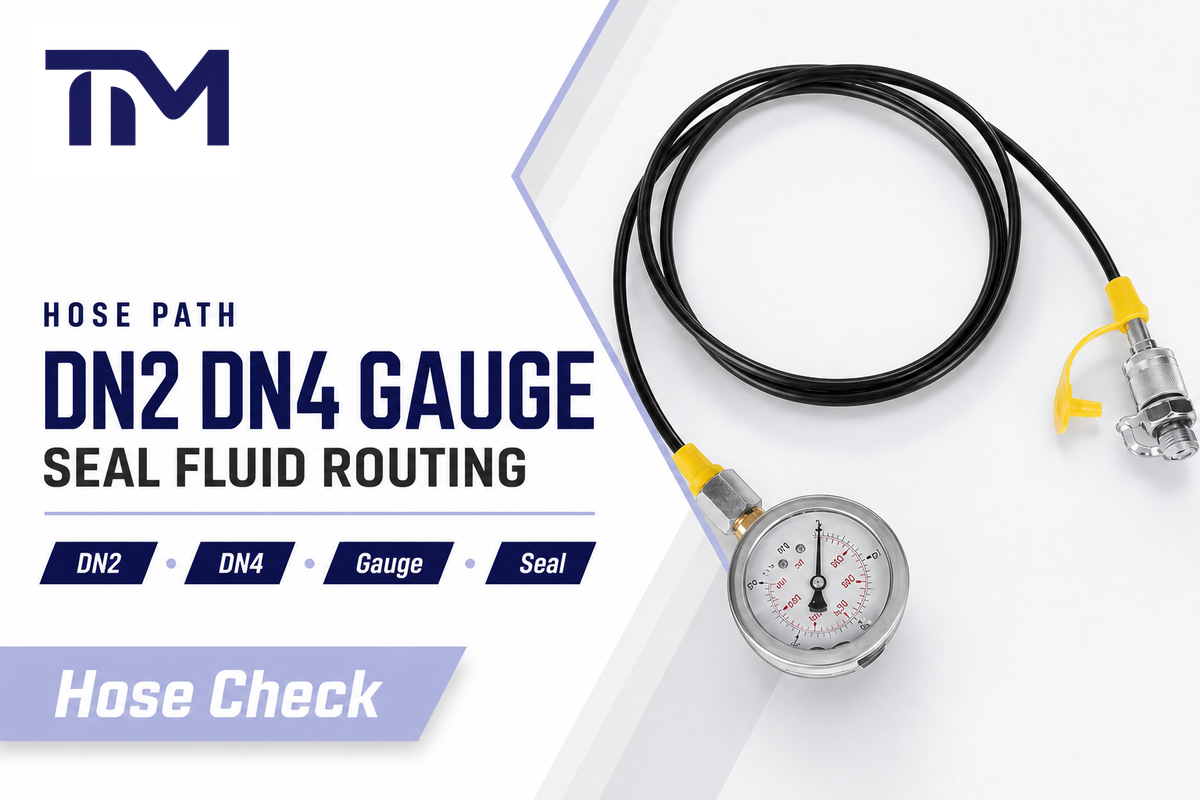
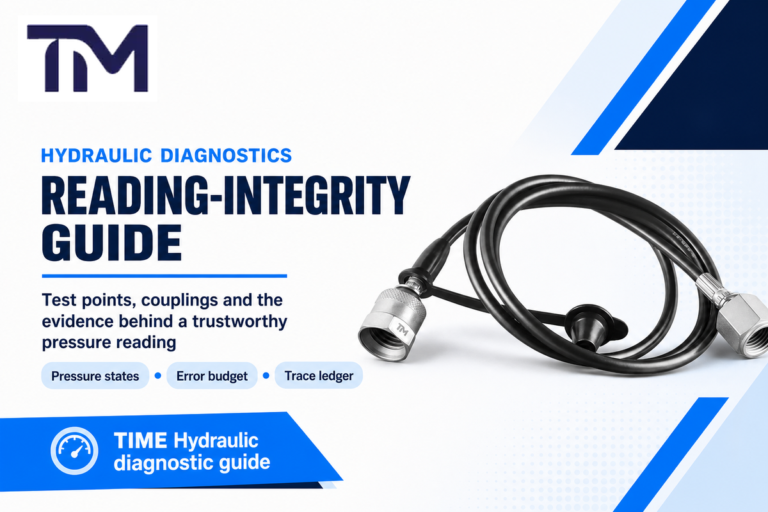
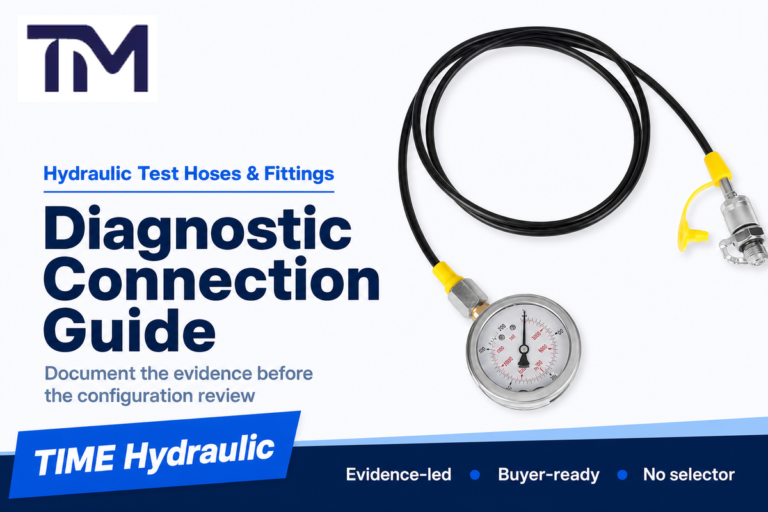
A coupling is just one element of the measurement chain. A standard-family candidate can still be incorrect if the hose bore, hose length, gauge range, sensor thread, adapter, seal material, or fluid is not appropriate for the hydraulic system.
For TIME drawing review, treat DN2 and DN4 as order-selection fields rather than assumptions. IKIN’s microbore guide identifies DN2 as 2 mm and DN4 as 4 mm, while the final TIME quote should confirm the exact hose bore, length, pressure rating, and fitting ends on the drawing. These are selection fields, not decoration, because bore and length affect routing, handling, fill volume, and measurement response.
- Hose bore: DN2 / 2 mm and DN4 / 4 mm require routing and response verification.
- Gauge or sensor side: validate thread, pressure range, and adapter stack.
- Seal material: NBR, FKM, EPDM, and other elastomers should be cross-referenced with fluid and temperature requirements.
- Fluid: mineral oil is compatible with the public ISO scope; other fluids require mutual agreement between supplier and purchaser.
- Documentation: request inspection, pressure testing, material traceability, and warranty scope for the completed assembly.
This is where a buyer can convert a standards inquiry into a viable RFQ. The standard helps define the family; the hose and gauge path make the order usable on the shop floor.
Cross-Reference Workflow for Replacement Orders
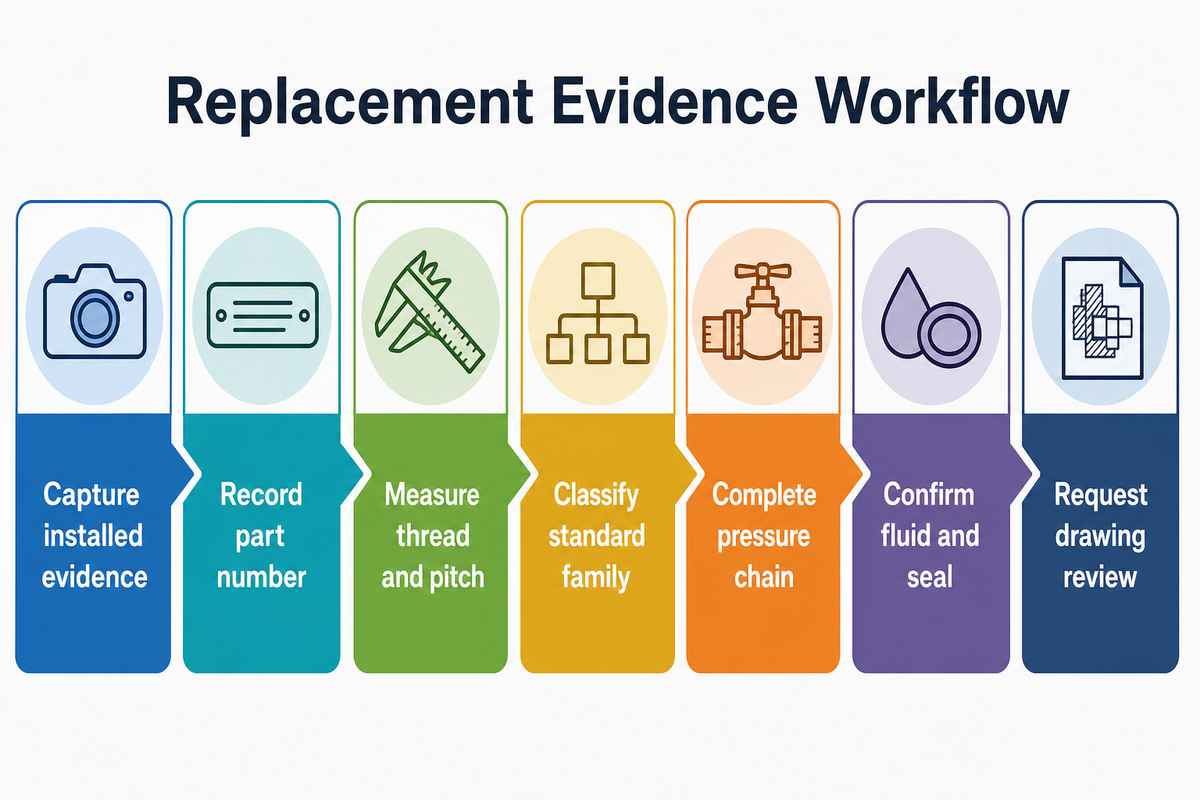
A replacement order should transition from evidence to part selection, not from an assumed series name to a quote. Use the official standard page as the family boundary, then begin with the legacy part number if available, photographs, thread dimensions, seal specifications, pressure requirements, fluid type, hose bore, gauge end, and machine model.
For plant maintenance and purchasing personnel, the workflow below supports urgent replacement work while still giving QA enough evidence to clear the order.
- Capture the installed evidence – take photos of the test point, seal face, port, and gauge or hose end.
- Record the nameplate and part number – include machine model, legacy supplier number, and any stamped code.
- Measure thread and pitch – confirm M16 x 2, M16 x 1.5, BSP, NPT, metric, JIC, or UNF instead of guessing from appearance.
- Classify the standard family – separate the M16 x 2 standard family from ISO 15171-1, SAE J1502, ISO 16028, and supplier-specific families.
- Complete the pressure chain – write live-connection need, working pressure, hose, gauge, adapter, and lowest confirmed rating.
- Confirm fluid and seal material – name mineral oil or the exact alternative fluid and expected seal material.
- Request supplier drawing review – ask TIME to confirm the candidate before sample or batch order approval.
If the previous part comes from STAUFF, Hydrotechnik, Parker, HAWE, Rexroth, Caterpillar, SANY, XCMG, or another machinery supplier, use the brand name to identify the initial family, then still demand the same evidence pack. Cross-branded sourcing is more reliable when all fields are visible.
TIME RFQ Checklist and Drawing Review
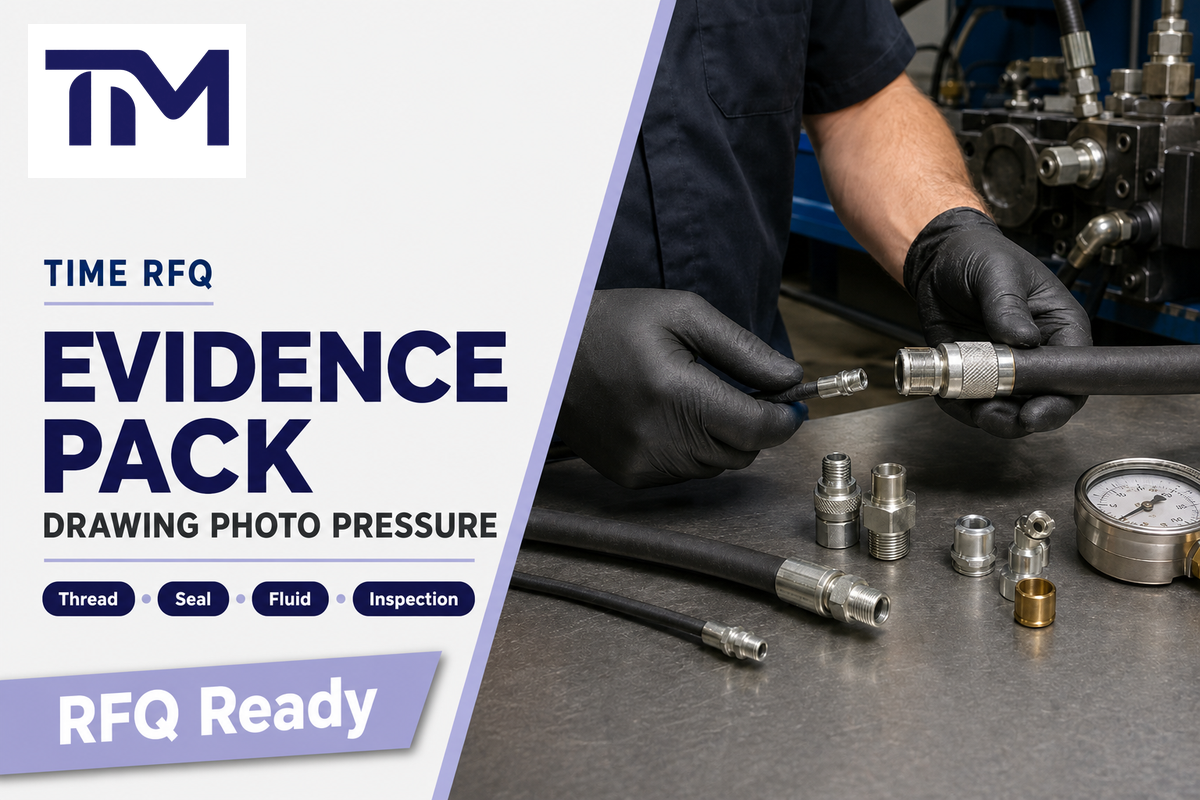
TIME Hydraulic specializes exclusively in hydraulic test points and hydraulic test hoses. IKIN is the registered trademark, and TIME Hydraulic is the operating company. For standards-compatibility work, the strongest request is not a vague quote. It is a Replacement RFQ Evidence Pack that lets engineering, procurement, and QA review the same facts.
According to the brand brief supplied for this article, TIME focuses on hydraulic test point and hose manufacturing, ISO and SGS certification claims, a 5,000 square meter production facility, new workshops under development, cone-seal and zero-leakage design practices, 100 percent inspection, and a 3 year quality warranty. Treat those as supplier-screening claims unless the supplier provides certificate scope, valid dates, current factory evidence, material records, testing method, and order-specific inspection records during approval.
Replacement RFQ Evidence Pack – copy these into your quote request:
| Field | What to send | Why it matters | How TIME can verify |
|---|---|---|---|
| Legacy part evidence | Part number, stamped code, supplier brand, machine model | Creates the first cross-reference path | Compare against drawing and catalog family |
| Diagnostic family | M16 x 2 standard family, STAUFF Test 20, Minimess 1620, or other family | Prevents cross-family substitution | Check mating half and connection end |
| Port or stud end | Drawing callout, thread size, pitch, BSP/NPT/metric/JIC/UNF details | Machine side may differ from diagnostic side | Review port photo and measurements |
| Seal form | Cone seal, O-ring, washer, face seal, flat seal, or sample part photo | Thread fit does not prove leak sealing | Compare section drawing or sample |
| Pressure requirement | Working pressure, live-connection need, gauge range | Separates live-connection limits from working-pressure claims | Check lowest-rated component |
| Hose assembly | DN2, DN4, hose length, bend path, adapter stack | Turns the test point into a usable measurement chain | Review custom hose assembly drawing |
| Fluid and seal material | Mineral oil or exact fluid, NBR/FKM/EPDM preference | Protects elastomer and compatibility assumptions | Confirm supplier and purchaser agreement |
| Inspection proof | Pressure test, material traceability, leakage inspection, warranty need | Makes supplier comparison auditable | Attach inspection or quality record |
| Commercial fields | Quantity, sample need, packing, brand/logo, delivery target | Links engineering approval to purchasing action | Confirm model, sample, and batch order route |
Need TIME to review a replacement?
Send the evidence pack, drawings, photos, thread measurements, pressure requirement, hose bore, hose length, fluid, gauge end, quantity, application, and target machine. TIME can review hydraulic test hose end fittings and custom test hose assemblies before sample or batch approval.
When Not to Claim Compatibility
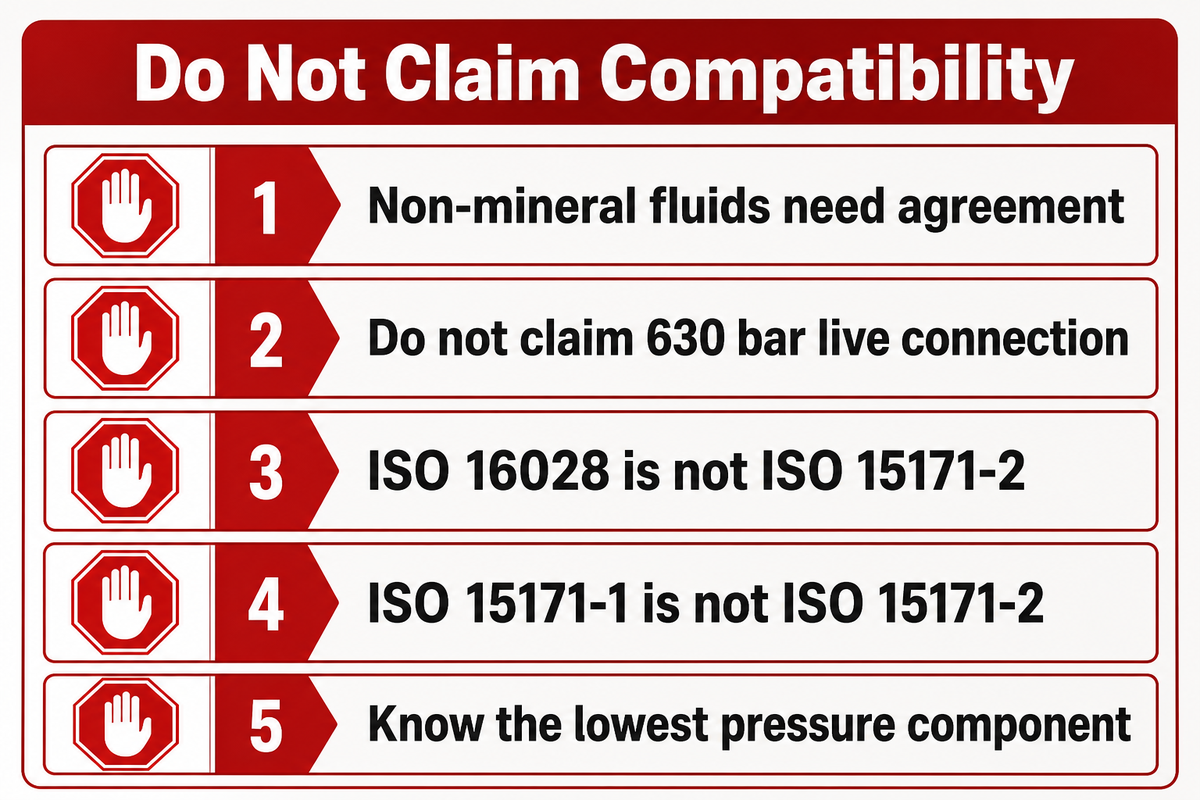
Do not claim standards compatibility when only thread diameter, a photo, or a supplier family name is known. Compatibility should be claimed only when the standard family, M16 x 2 interface, port or stud end, seal path, pressure chain, fluid, hose, gauge, and documentation all agree.
This rule is strict because hydraulic test points are used on pressurized fluid power systems. A poor replacement can create leakage, wrong readings, downtime, and unsafe troubleshooting behavior. Often, the safer answer is “candidate match pending drawing review,” not “compatible.”
- Do not claim compatibility with non-mineral fluids unless the supplier and purchaser agree on the exact fluid, seal material, and material scope.
- Do not claim live connection at the higher working-pressure rating from public-page wording.
- Do not treat ISO 16028 flush-face quick-action couplings as this standard’s live diagnostic test points.
- Do not treat ISO 15171-1 flat-face diagnostic couplings as this standard’s M16 x 2 replacements.
- Do not approve the hose assembly until the lowest working-pressure component is known.
Key takeaway
The standard helps identify the M16 x 2 diagnostic-coupling family, but the replacement is not safe to approve until the port, seal, pressure, fluid, hose, gauge, and inspection chain are proven.
FAQ
Is the M16x2 standard the same as Minimess M16x2?
No. It is a standard scope for hydraulic diagnostic couplings with an M16 x 2 interface, while Minimess M16x2 is a market and series-style search term that can point buyers toward a candidate family. Treat Minimess 1620 or Test 20 language as a useful clue, then confirm the exact part number, mating half, port or stud end, seal path, pressure, fluid, and hose or gauge interface before approving a replacement.
Can M16x2 couplings connect under 630 bar pressure?
Do not make that claim from the public page alone. The public standard wording supports connection under pressure without tools to a maximum pressure of 40 MPa, and it should be worded as connected under pressure without tools only inside that context.
That 63 MPa figure is a separate maximum working-pressure context with application caveats. A finished assembly can only be approved to the lowest confirmed rating across the coupling, hose, adapter, gauge, seal, valve, and installed port. If a supplier markets a higher-rated item, ask whether that number applies to working pressure, proof pressure, burst pressure, or live connection.
What makes M16x2 different from M16x1.5 test points?
Pitch is the difference, and that difference can put the part in a different diagnostic series or mating family. M16 x 2 is tied to the M16 x 2 diagnostic connection-end scope; M16 x 1.5 appears in other test-point families such as STAUFF Test 15 or Minimess 1615 contexts. Do not substitute one for the other because the outside diameter looks close. Confirm pitch, mating half, seal, pressure, and supplier drawing.
Is ISO 16028 compatible with the M16x2 diagnostic standard?
No automatic compatibility should be claimed. ISO 16028 is a flush-face quick-action coupling standard, while the M16x2 standard addresses diagnostic couplings with an M16 x 2 interface for connection under pressure. Application, mating geometry, pressure range, and standard family are different.
What thread details should I send before ordering?
Send the installed-port photo, male or female side, thread diameter, pitch, straight or tapered form, seal-face photo, part number, machine model, pressure requirement, fluid, hose bore, hose length, gauge or sensor thread, and quantity. Add a drawing if available. A single M16x2 note is not enough for replacement approval.
How does TIME check compatibility before shipment?
TIME reviews the requested diagnostic family, machine-side port or stud end, seal path, pressure requirement, fluid, hose bore, hose length, instrument end, and inspection needs against its hydraulic test point and test hose manufacturing scope. TIME’s supplied brand context includes hydraulic test points and hoses only, cone-seal and zero-leakage design practices, 100 percent inspection, ISO/SGS certification claims, and a 3 year quality warranty.
For a replacement order, that means TIME should receive the legacy part number, installed photo, thread measurement, seal-face photo, fluid, pressure duty, and gauge or sensor end before final model selection. Buyers should still confirm certificate scope, warranty scope, material, pressure-test method, and order-specific inspection proof, because those fields turn a catalog match into a shipment record QA can audit.
Does the standard cover non-mineral hydraulic fluids?
Public scope is framed around mineral-oil hydraulic systems. Fluids other than mineral oil should not be assumed compatible from the standard name alone. State the exact fluid and ask the supplier to confirm seal material, material compatibility, and agreement between the supplier and the purchaser.
Turn an M16x2 clue into a quote-ready test point specification
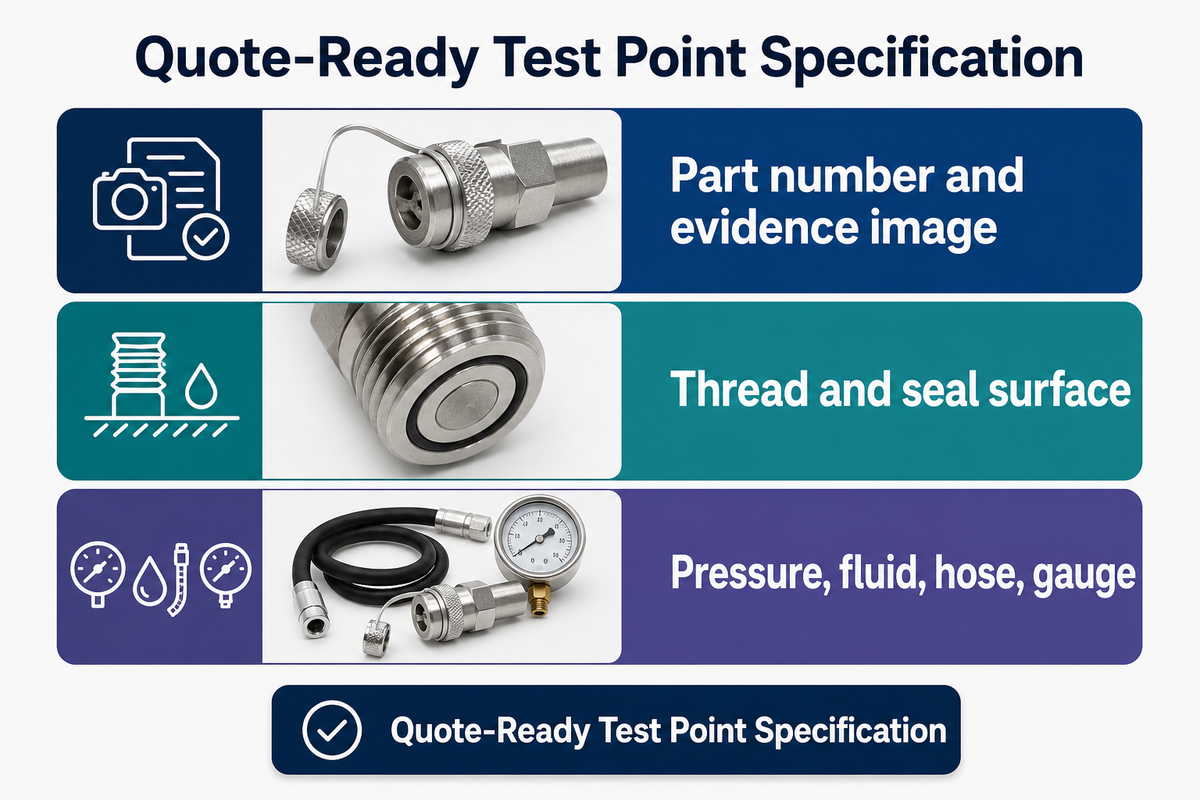
TIME Hydraulic can review your part number, port photo, thread measurement, seal surface, pressure requirement, fluid, hose bore, hose length, and gauge or sensor end before sample or batch production, using the public standard scope as the standard-family boundary.
Related TIME Guides
- Hydraulic test hose end fittings for BSP, NPT, metric, JIC, M16 x 2, seal, and adapter selection.
- Custom test hose assemblies for hose bore, hose length, fitting-end, gauge, and sensor-side review.
- Hydraulic test point selection guide for broader pressure, port, hose, fluid, and ordering checks.
- Pressure gauge connector guide for instrument-side connection planning.
References & Sources
- Official 2016 standard page – International Organization for Standardization public page for diagnostic coupling scope, lifecycle status, pressure context, and fluid caveat.
- Online Browsing Platform entry for the 2016 standard – public ISO surface used for stud-end reference checks.
- ISO 16028:2023 official page – International Organization for Standardization public page for flush-face quick-action coupling boundary context.
- SAE J1502_202205 official standard page – SAE International public page for diagnostic coupling boundary context.
- US8689828B2 hydraulic coupling patent record – Google Patents record used only as adjacent pressure-relief coupling context.